
July 26, 2026
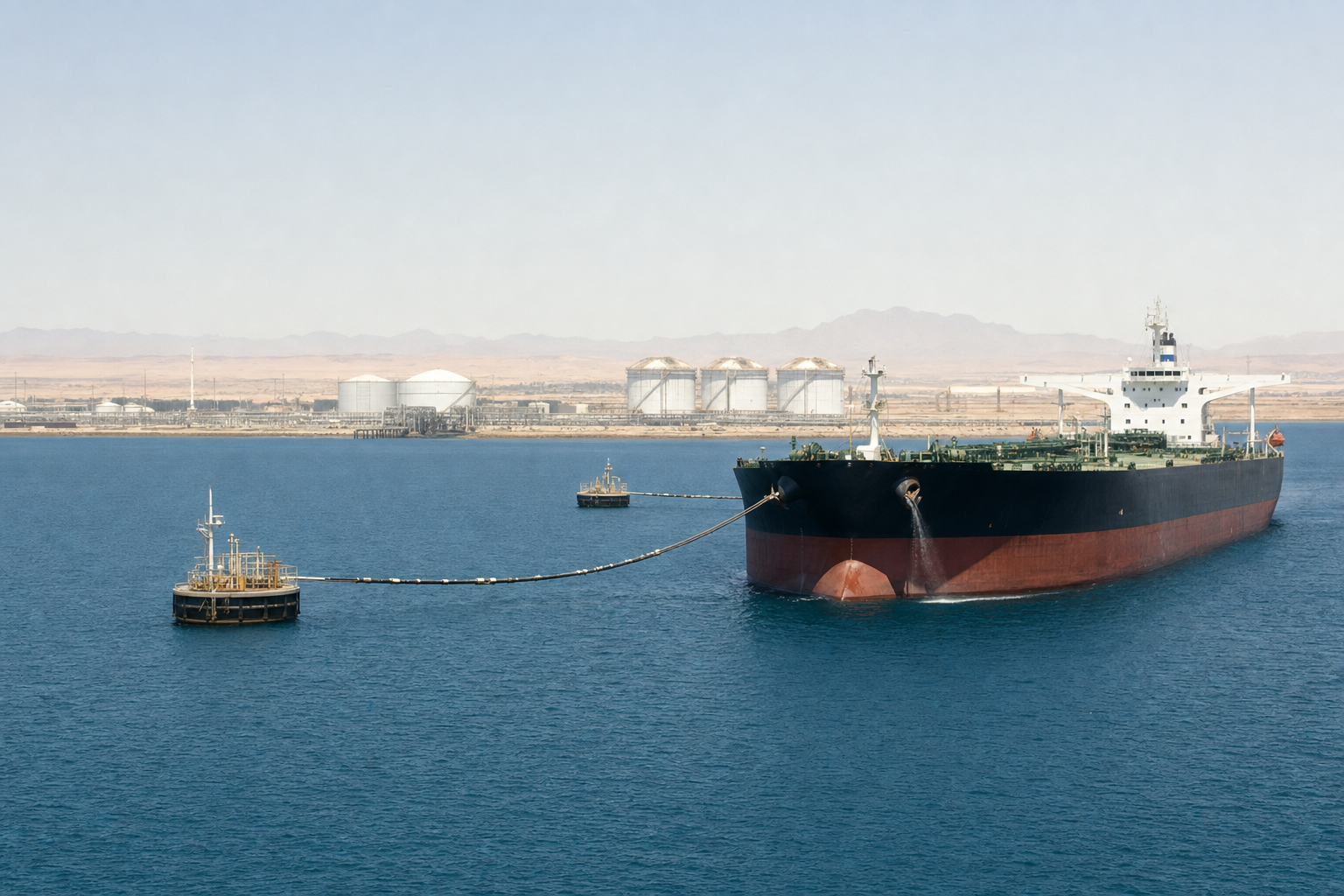
From Hormuz Hedge to Red Sea Exposure
For years, Saudi Arabia’s strategic contingency for any disruption in the Strait of Hormuz has been to move crude west via the East–West Pipeline to the Red Sea port of Yanbu. That pathway has been viewed as a reliable hedge, enhancing supply security by reducing reliance on Gulf export terminals. The logic was straightforward: if the Gulf route is constrained, shift barrels to the Red Sea and load them there.
Current conditions in the Red Sea, particularly around the Bab el‑Mandeb strait, have complicated that assumption. The pipeline still provides valuable routing flexibility inside the Kingdom, but once crude reaches Yanbu it remains dependent on an increasingly strained maritime corridor. In effect, risk is not eliminated; it is relocated from one chokepoint to another within a narrower seaborne funnel.
Market and Shipping Implications
The emergence of the Red Sea as a bottleneck reshapes how traders, refiners and shippers account for route optionality. Tanker scheduling becomes more complex when both primary exit routes from the Arabian Peninsula carry elevated operational uncertainty. Freight markets typically respond to such constraints with tighter vessel availability, wider route differentials and shifting preferred load ports as participants seek more predictable liftings. Storage and blending strategies at coastal terminals can also come under pressure when berth availability and sailing windows are less certain.
For crude buyers, the practical effect is a thinner buffer against delay. Even where production and inland pipeline flows are stable, throughput to end‑users still hinges on safe, timely passage through the Red Sea corridor. That linkage can transmit localized maritime stresses into broader timespreads and inter‑basin arbitrage, influencing which grades clear into which refining systems at any given moment.
Strategic Context
Saudi Arabia’s East–West system remains a critical asset, ensuring that volumes can reach a western load point without transiting Hormuz. Yet the present Red Sea environment underscores the limits of inland rerouting as a comprehensive solution. When downstream waterways face their own constraints, pipeline diversification alone cannot insulate exports from seaborne risk.
This recalibration is less about headline production policy and more about the mechanics of flow assurance. It highlights how energy security today is defined not only by output capacity and spare production, but by the resilience of multiple maritime passages that ultimately determine delivery reliability. In that framework, redundancy is valuable, but chokepoint dependence persists so long as crude must traverse narrow, high‑traffic sea lanes.
Unlike seaborne energy cargoes, allocated vaulted precious metals are not exposed to transit chokepoints or shipping disruptions.